In today’s fast-paced world, our desks have become more than just work surfaces. They are command centers, creative studios, planning hubs, and sometimes even dining tables. Yet as our responsibilities multiply, so does the clutter—cables tangled like vines, sticky notes scattered across the surface, pens disappearing into drawers, and small tools buried under paper stacks. A well-designed desk organizer is no longer a luxury; it’s a necessity.
Enter the Laser Cut Modular Desk Organizer—a modern solution that blends precision engineering, smart design, sustainability, and aesthetic elegance into one adaptable system. This article explores what makes laser-cut modular organizers exceptional, how they are designed and manufactured, their practical benefits, material choices, customization possibilities, and why they represent the future of workspace organization.
The Evolution of Desk Organization
Desk organizers have existed for decades. Traditional models were typically injection-molded plastic trays or heavy wooden boxes with fixed compartments. While functional, they often lacked flexibility. If your needs changed, the organizer didn’t adapt—you replaced it.
The modern professional, however, needs more:
- Devices with varying sizes (phones, tablets, headphones)
- Charging cables and hubs
- Notebooks, planners, and sticky notes
- Creative tools such as brushes, styluses, or drafting tools
- Personal items that make a workspace feel welcoming
A single rigid organizer rarely accommodates all of these. The demand for flexibility and customization led to the rise of modular desk systems, and when combined with laser cutting technology, a new level of precision and personalization became possible.
What Is a Laser Cut Modular Desk Organizer?
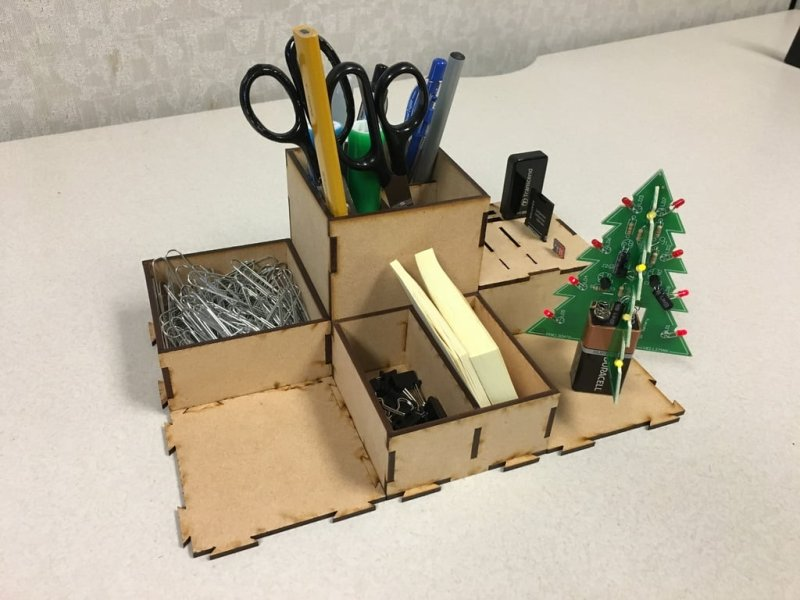
A Laser Cut Modular Desk Organizer is a collection of precisely fabricated components—typically made from wood, acrylic, MDF, bamboo, or metal—that interlock or assemble into customizable configurations. Each piece is cut using a laser cutter, ensuring:
- Extremely accurate dimensions
- Clean, sharp edges
- Intricate detailing
- Consistent repeatability
“Modular” means the system is composed of separate units that can be rearranged, expanded, or reconfigured depending on user needs. Instead of one fixed organizer, you have a system that evolves with your workspace.
The Power of Laser Cutting Technology
Laser cutting has revolutionized modern product design. Unlike traditional cutting methods, laser cutters use a high-powered beam to slice through materials with exceptional accuracy. The advantages include:
1. Precision Engineering
Laser cutters can achieve tolerances as tight as fractions of a millimeter. This is especially important for modular systems that rely on interlocking joints. When pieces fit perfectly, the structure becomes stable without excessive adhesives or fasteners.
2. Intricate Design Capabilities
Complex geometric patterns, engraving details, and customized branding are easily achieved. Decorative cutouts, cable-routing slots, ventilation holes, and personalized engravings can be integrated seamlessly.
3. Clean Edges
Laser-cut edges are smooth and often require minimal finishing. This contributes to a professional, high-end appearance.
4. Efficient Production
Digital designs can be modified quickly and sent directly to the laser cutter. This makes small-batch production and customization cost-effective.
Laser cutting transforms what could be a simple organizer into a refined, thoughtfully engineered product.
Modular Design: Flexibility at Its Core
The defining feature of a modular desk organizer is adaptability. Instead of a fixed layout, modules can include:
- Pen holders
- Document trays
- Phone stands
- Tablet docks
- Cable management boxes
- Drawer units
- Vertical file slots
- Accessory trays
Users can combine these modules in countless configurations. For example:
- A minimalist setup might include only a pen holder, phone stand, and slim tray.
- A creative professional might integrate multiple tool holders and open compartments.
- A tech-heavy workspace might prioritize cable-routing modules and device stands.
This flexibility makes the organizer suitable for students, designers, engineers, executives, and remote workers alike.
Material Choices and Their Impact
Material selection plays a significant role in both aesthetics and functionality.
1. Plywood and Birch
Laser-cut birch plywood is a popular choice due to its strength, layered aesthetic, and sustainability. It offers a warm, natural feel that complements modern interiors.
2. MDF (Medium-Density Fiberboard)
MDF provides a smooth surface ideal for painted finishes. It is affordable and suitable for sleek monochrome designs.
3. Bamboo
Bamboo is eco-friendly, durable, and visually appealing. It adds a natural elegance while promoting sustainability.
4. Acrylic
For a contemporary or futuristic look, acrylic modules offer transparency or bold color options. They are ideal for modern offices and creative studios.
5. Powder-Coated Metal
Laser-cut metal components provide industrial durability and long-term resilience. They are excellent for heavy-duty setups.
Each material brings a unique personality to the organizer, allowing users to match their desk system to their workspace aesthetic.
Ergonomics and Productivity
An organized desk is not just visually pleasing—it directly impacts productivity and mental clarity. Studies consistently show that clutter can increase stress and reduce focus.
A well-designed laser cut modular desk organizer supports productivity by:
- Reducing time spent searching for items
- Keeping essential tools within arm’s reach
- Improving cable management
- Encouraging intentional workspace design
Ergonomic considerations can also be integrated into the design. Phone and tablet stands can be angled to reduce neck strain. Raised compartments can improve posture by elevating frequently viewed devices.
The result is not only a cleaner desk but also a healthier working environment.
Customization and Personalization
One of the greatest advantages of laser-cut production is personalization.
Engraving Options
Names, company logos, motivational quotes, or decorative patterns can be engraved directly onto the surface.
Custom Module Dimensions
Designers can create modules sized precisely for specific devices, notebooks, or tools.
Color and Finish Variations
Stained wood, painted MDF, tinted acrylic, or natural finishes allow users to express personal style.
Expandable Systems
As needs grow, additional modules can be added without replacing the entire system.
Personalization transforms a desk organizer from a utility product into a statement piece.
Sustainability and Environmental Considerations
Sustainability is increasingly important in modern design. Laser cut modular organizers can contribute to eco-friendly practices in several ways:
- Efficient material usage: Digital nesting techniques minimize waste.
- Flat-pack shipping: Reduced packaging and lower carbon footprint.
- Sustainable materials: Bamboo and FSC-certified plywood promote responsible sourcing.
- Longevity: Modular systems reduce the need for frequent replacement.
Instead of discarding an outdated organizer, users simply rearrange or add modules.
Assembly and User Experience
Most laser cut modular desk organizers are designed for easy assembly. Interlocking joints, tab-and-slot systems, or minimal hardware ensure:
- Tool-free or low-tool assembly
- Quick setup
- Secure, stable construction
Clear instructions and intuitive design enhance the user experience. Many systems also allow disassembly, making relocation simple.
The assembly process itself can even be enjoyable—similar to constructing a puzzle, reinforcing engagement with the product.
Applications Across Different Workspaces
The versatility of modular organizers makes them suitable for a wide range of environments:
Home Offices
Remote workers benefit from customizable layouts that maximize limited space.
Corporate Offices
Companies can standardize desk organization while allowing minor personalization.
Creative Studios
Artists and designers can adapt modules to fit tools, brushes, or sketchbooks.
Educational Settings
Students can keep textbooks, stationery, and devices neatly organized.
Workshops
Laser-cut organizers can be adapted for tools and hardware storage.
The adaptability makes them universally relevant.
Aesthetic Integration in Interior Design
Modern workspaces emphasize cohesion between furniture, technology, and décor. A laser cut modular desk organizer can be designed to complement:
- Scandinavian minimalism
- Industrial loft interiors
- Contemporary corporate settings
- Warm rustic home offices
Through careful material selection and clean geometry, these organizers enhance rather than disrupt visual harmony.
Design Considerations for Manufacturers
For designers and manufacturers, several key considerations influence product success:
- Structural Stability: Modules must lock securely without wobbling.
- Scalability: Designs should allow future module expansions.
- Material Thickness Compatibility: Joint dimensions must account for exact material thickness.
- Ease of Manufacturing: Designs should optimize cutting time and material usage.
- User-Centered Design: Real-world testing ensures practicality.
Successful products balance engineering precision with aesthetic simplicity.
The Future of Desk Organization
As workspaces continue to evolve, desk organization will follow. Trends shaping the future include:
- Smart integration (wireless charging modules)
- Sustainable material innovation
- AI-assisted workspace design planning
- Hybrid home-office adaptability
Laser cutting technology will remain central because of its adaptability, speed, and precision.
Why Choose a Laser Cut Modular Desk Organizer?
To summarize, a laser cut modular desk organizer offers:
- Precision-crafted components
- Customizable configurations
- Aesthetic versatility
- Sustainable design potential
- Long-term adaptability
- Enhanced productivity
Unlike traditional organizers, it grows with your needs and reflects your personal style.
Conclusion
The Laser Cut Modular Desk Organizer represents the intersection of design innovation, technology, and practical functionality. In a world where workspaces must adapt to dynamic demands, a static solution is no longer sufficient.
Through precise laser-cut engineering, modular flexibility, sustainable materials, and aesthetic customization, this modern organizer elevates the concept of desk management from mere storage to intentional design. It empowers users to create environments that foster clarity, efficiency, and creativity.
As our work habits continue to evolve, one thing remains certain: organization is the foundation of productivity. And with a laser cut modular desk organizer, that foundation is built with precision, adaptability, and style.
